
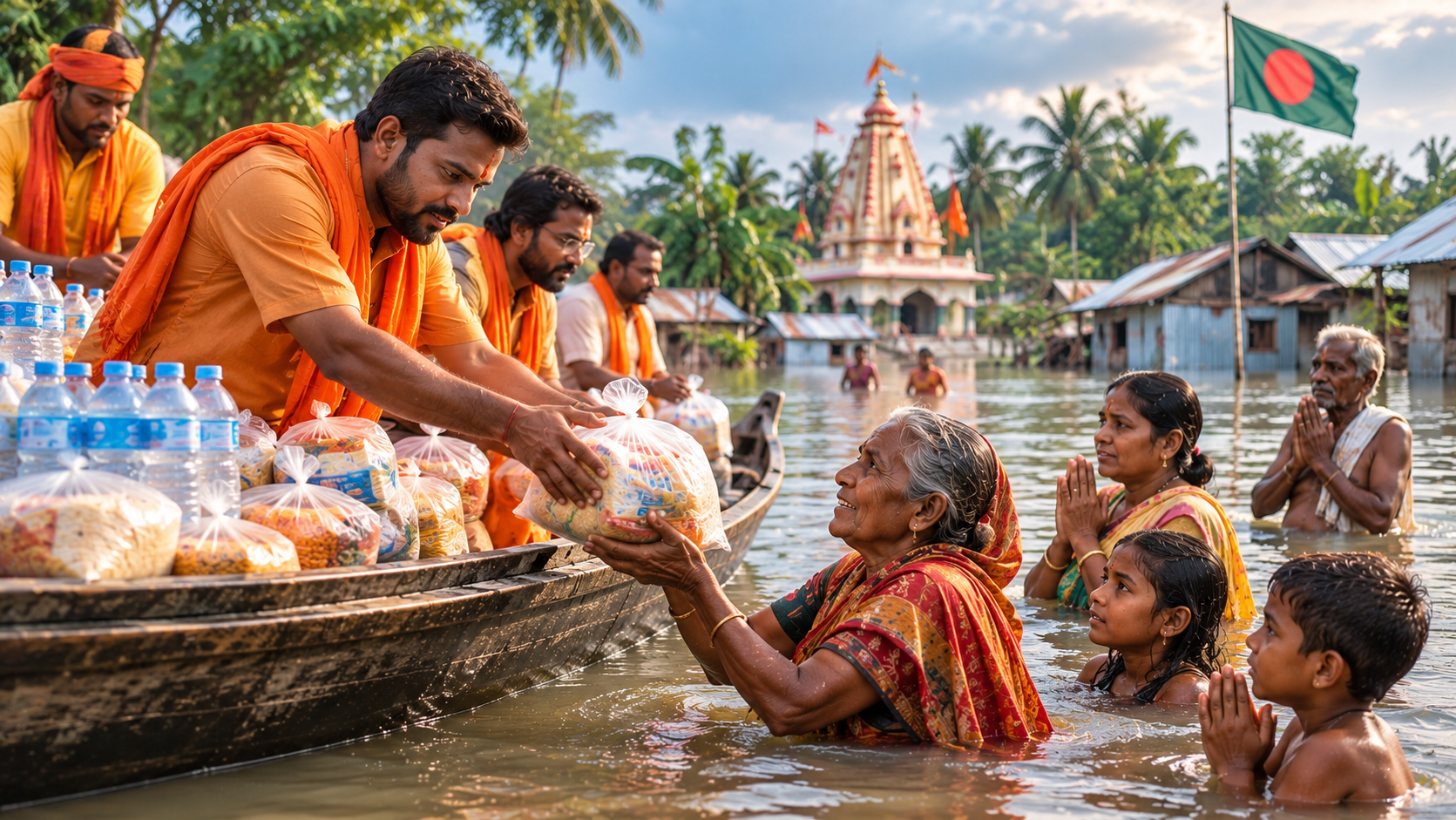
Floods can transform everyday life in a matter of hours. Roads disappear beneath water, homes become difficult to access, supplies run low, and families can suddenly find themselves facing uncertainty with nowhere to turn.
Across flood-affected communities in Bangladesh, local volunteers have been stepping forward to help families facing these difficult circumstances. Carrying drinking water and food packets through flooded areas, they have been working with limited resources to reach people who need immediate assistance.
For the volunteers, the work is not simply about distributing supplies. It is about making sure vulnerable families know that someone is there for them.
Reaching Communities in Difficult Times
The recent flood-relief efforts are part of a wider community presence that has developed over several years.
Since 2022, the Global Hindu Heritage Foundation (GHHF) has been involved with communities in Bangladesh through Bala Samskar Kendras, cultural programmes, festival celebrations, Annadanam, and other community activities.
The Bala Samskar Kendras were established to provide children with opportunities to learn Vedic shlokas, Bhagavad Gita verses, Vedic chanting, and aspects of Hindu cultural heritage.
Over time, these activities created relationships that extended beyond the classroom and festival calendar. When communities began facing the devastating effects of flooding, those local connections became important in identifying families who needed assistance.
Carrying Relief Through the Floodwaters
In many affected areas, the most basic necessities can become difficult to obtain.
Clean drinking water, food, transportation and safe shelter become immediate priorities. For families unable to leave their homes or reach markets and relief points, even a small amount of assistance can make a significant difference.
Volunteers have therefore been going directly into affected areas, carrying bottles of water and small packages of food.
The work is often carried out under difficult conditions, with flooded roads and limited equipment making movement challenging.
Yet the volunteers continue to make the journey.
Their efforts demonstrate an important principle of disaster response: help is most meaningful when it reaches people where they are.
A Community Facing More Than One Challenge
For sections of Bangladesh’s Hindu minority, natural disasters can come against the backdrop of longer-standing concerns about security and discrimination.
Hindu communities in Bangladesh have, at different times, faced reports of attacks, intimidation, vandalism, threats and violence. Concerns over the safety of Hindu homes, temples, businesses and families have remained an important part of conversations surrounding minority rights in the country.
GHHF has previously raised concerns about such incidents and says some of its own local volunteers and community members have faced threats and physical attacks while carrying out community activities.
These circumstances can make humanitarian work particularly difficult. For vulnerable families already coping with displacement, damaged homes and shortages of basic necessities, insecurity can add another layer of fear and uncertainty.
Against this backdrop, the decision of local volunteers to continue visiting affected families carries significance beyond the delivery of food and water. It represents a commitment to remain present within communities during difficult times.
A Community Effort Built Over Time
The humanitarian response did not emerge in isolation.
The foundation’s activities in Bangladesh have included educational programmes for children, support for religious and cultural celebrations, and Annadanam for families in need.
Durga Puja celebrations, for instance, have included the distribution of food and clothing to economically disadvantaged Hindu families. Sri Krishna Janmashtami has also been observed through large community celebrations.
These initiatives have helped establish a continuing presence within local communities.
When an emergency arrives, such relationships can become a valuable foundation for organizing assistance quickly and understanding where help is needed most.
Volunteers at the Heart of the Response
Disaster relief is rarely easy.
Volunteers may have to navigate damaged roads, heavy rain and flooded areas while carrying supplies. Resources may be limited, and reaching isolated families can require considerable effort.
Despite these challenges, local volunteers associated with GHHF have continued their relief activities in flood-affected areas, providing food and drinking water and helping people move toward safer locations where possible.
Their role highlights something that is often overlooked in discussions about disaster relief: humanitarian work frequently begins with ordinary people willing to step forward.
They may not have large fleets of vehicles or sophisticated equipment. What they have is local knowledge, determination and a willingness to help.
Standing With Vulnerable Families
Floods do not affect every family equally.
Those with fewer resources often have fewer options when homes are damaged, livelihoods are interrupted or essential supplies become unavailable.
For such families, community support can provide an important lifeline.
The current relief effort has focused particularly on areas with Hindu populations, with volunteers attempting to reach families who require food, water and assistance during the crisis.
The objective is immediate and practical: help families get through the difficult days and ensure that those who are most vulnerable are not overlooked.
From Cultural Work to Community Service
The story of these volunteers also reflects the broader role that community organizations can play.
An organization may begin with education or cultural preservation, but its relationships with local people can naturally extend into social and humanitarian service.
The work in Bangladesh has developed along these lines.
Bala Samskar Kendras engage children. Festival programmes bring communities together. Annadanam provides food. And during an emergency, volunteers can mobilize to provide basic necessities to families affected by disaster.
Each activity is different, but together they contribute to a stronger sense of community.
The Human Side of Disaster Relief
Statistics can describe the scale of a flood, but they cannot fully describe what it means for an individual family.
Behind every affected household are parents worrying about their children, elderly people trying to remain safe, families concerned about food and drinking water, and communities wondering when normal life will return.
For Hindu families who may already feel vulnerable because of insecurity or previous incidents of intimidation and violence, the impact of a natural disaster can be even more difficult.
That is why the presence of volunteers matters.
A packet of food may be small. A bottle of water may seem ordinary. But when delivered to someone who has been unable to access basic necessities, it becomes a tangible expression of solidarity.
Support That Can Keep the Work Moving
Local relief efforts depend heavily on available resources.
Volunteers may be ready to help, but transportation, food, drinking water, medical supplies and other necessities require funding and logistical support.
As flooding continues to affect communities, sustained assistance can allow volunteers to continue reaching families and responding to changing needs.
The work is ultimately a collective effort. Those on the ground provide the time and physical effort, while supporters can help provide the resources that make that effort possible.
When Helping Becomes a Responsibility
The real meaning of community often becomes clearest during a crisis.
When circumstances are difficult, when roads are flooded and resources are limited, choosing to go out and help someone else becomes more than an activity. It becomes an act of responsibility.
The volunteers working in Bangladesh are demonstrating that spirit by continuing to reach families affected by the floods.
Their work is a reminder that humanitarian service does not always begin with large institutions or elaborate plans. Sometimes it begins with a person carrying a bottle of water, walking through difficult conditions, and knocking on a family’s door.
For communities facing both the uncertainty of natural disasters and concerns about their security, knowing that others are willing to stand beside them can be deeply meaningful.
When the waters rise and uncertainty spreads, a helping hand can become a source of hope.

Sai Srinivas