
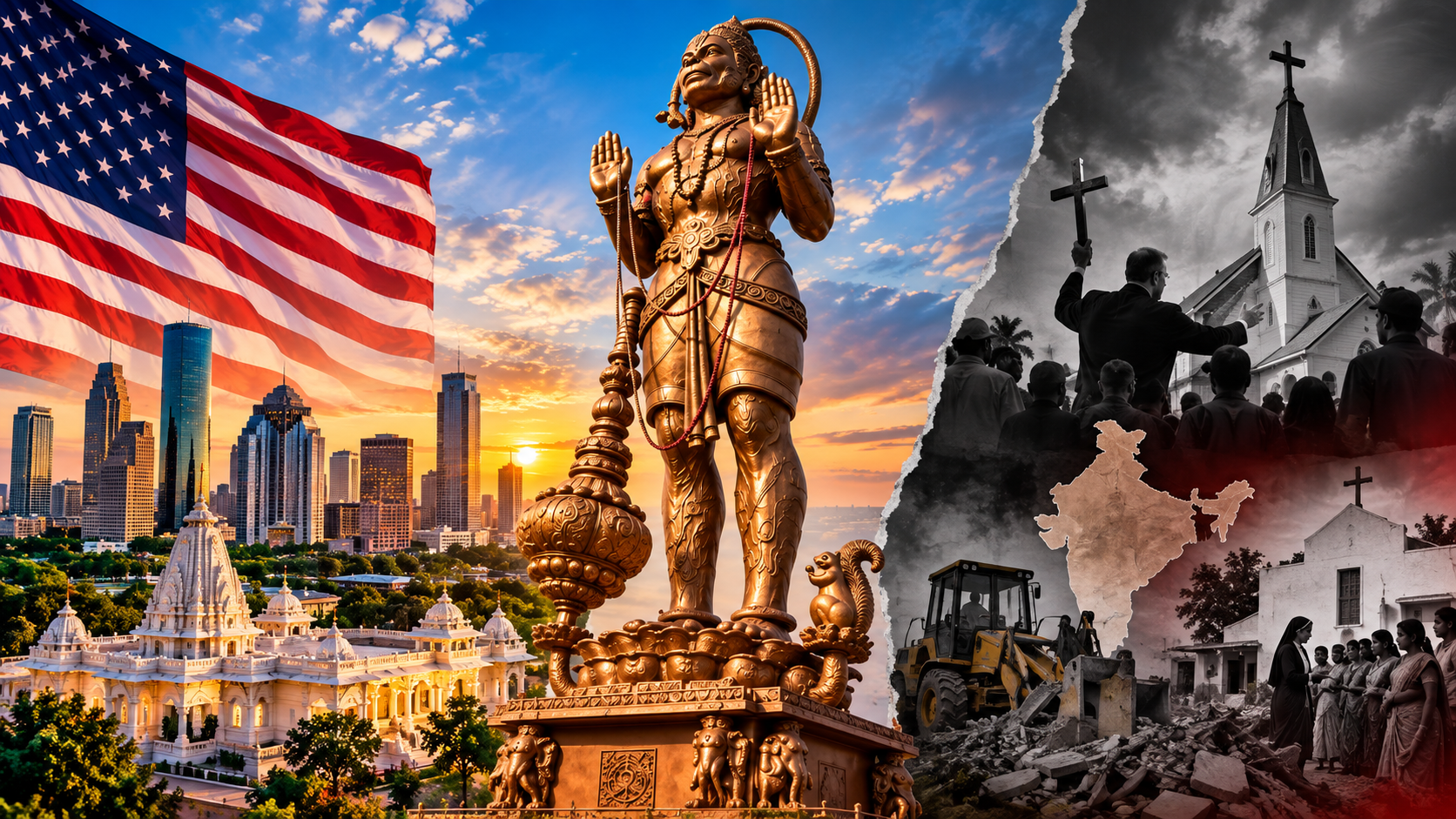
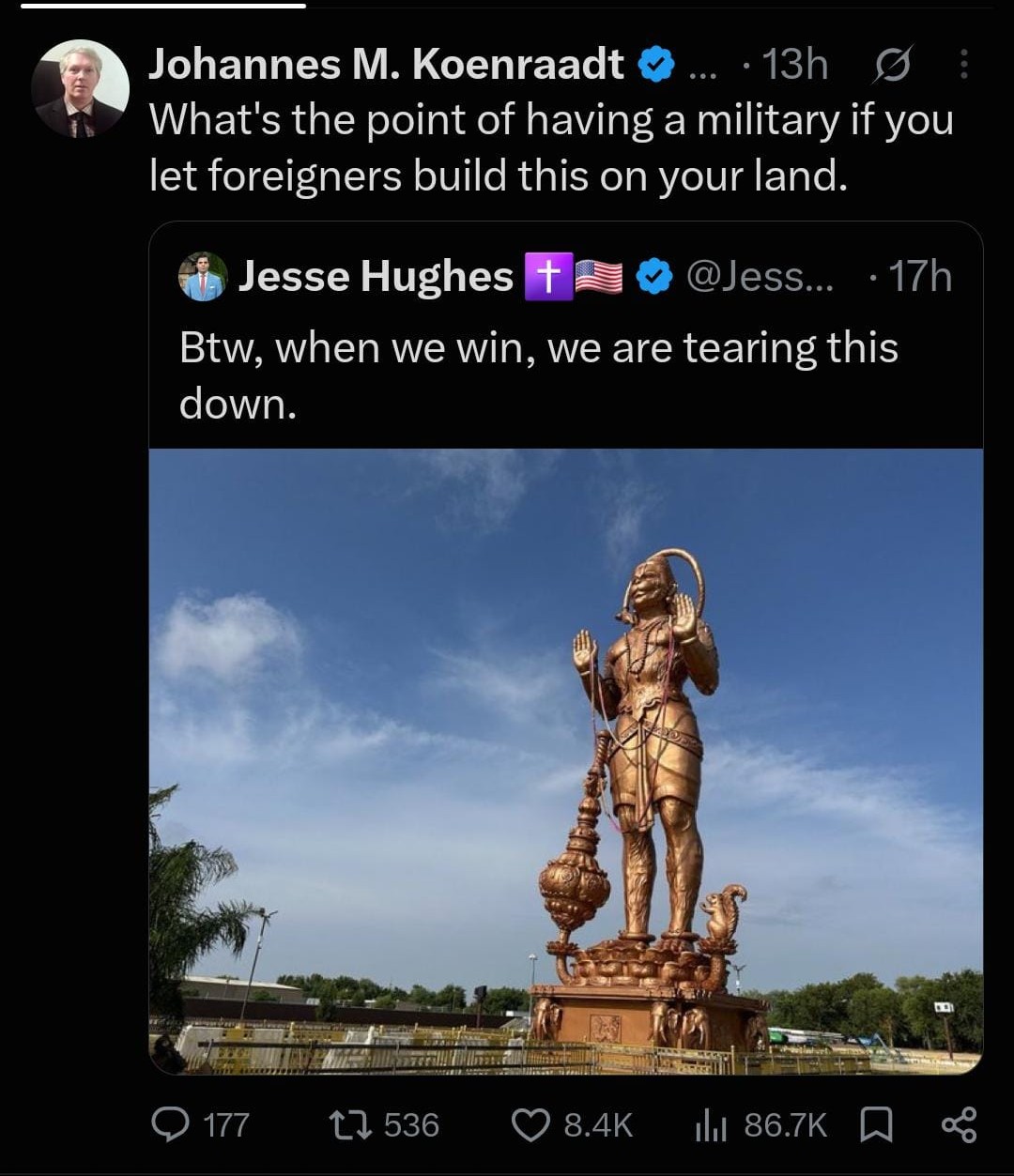
The controversy surrounding the 90-foot Hanuman statue at the Sri Ashtalakshmi Temple in Sugar Land, Texas, has become far larger than a disagreement over a religious monument. Social-media posts have portrayed the statue as evidence of an “invasion” by Indian immigrants and questioned why such a monument exists in America. Those claims need to be examined against the documented facts rather than political or religious rhetoric.
The monument, officially known as the Statue of Union, stands at the Sri Ashtalakshmi Temple on Synott Road in Sugar Land. It is approximately 90 feet tall and was unveiled in August 2024. Temple organizers describe the monument as a representation of Hanuman, a central figure in Sanatan Dharma associated with devotion, courage, strength and selfless service. Reporting from the Houston Chronicle stated that the project involved permits, engineering considerations and construction designed for the weather conditions of the Houston region.
That matters because the central question is not whether someone personally likes a Hanuman statue. The relevant legal questions are whether the land was lawfully held, whether required permissions were obtained and whether applicable zoning, construction and safety regulations were followed. If someone has evidence that the structure violates a specific law, that evidence can be presented to the appropriate authorities. But calling a Hindu monument an “invasion” does not establish a violation of American law.
The Statue Was Not a Foreign Occupation
The rhetoric surrounding the monument deliberately collapses several completely different concepts. An immigrant is not a foreign government. A Hindu American is not an occupying soldier. A temple is not an embassy. A religious monument does not transfer sovereignty over the land on which it stands.
A Hindu community establishing a temple and a large religious monument in the United States is not, by itself, evidence of foreign occupation. The same principle would apply to any religious community whose traditions originated outside the United States. America contains churches, synagogues, mosques, Hindu temples, Buddhist temples and Sikh gurdwaras representing traditions with origins in many different parts of the world.
Their existence does not mean that the countries from which those religions originated have acquired American territory.
A Hanuman statue therefore does not make Texas Indian territory any more than a church makes Texas the property of another country.
The Religious Conflict Has Also Been Documented
The dispute around the temple did not begin with recent social-media commentary. In 2024, members of the Awakening Generation Church gathered near the statue, prayed and preached to temple visitors. The Houston Chronicle reported that members told visitors that Jesus was the only God. Temple representatives said the activity made some visitors uncomfortable and subsequently arranged additional security, while the church’s pastor described the activity as an effort to pray for the salvation of people in Sugar Land.
Those competing accounts are important because they show that the controversy has included an explicit religious disagreement from the beginning. Christians have the right to hold Christian beliefs, just as Hindus have the right to hold Hindu beliefs. But the existence of disagreement over theology does not establish that either community has the right to dictate what the other community may lawfully worship.
A Christian does not have to believe in Hanuman. A Hindu does not have to accept Christian theology. Religious freedom means that disagreement does not automatically become a justification for suppressing another community’s lawful religious expression.
If the Argument Is About Law Then Apply the Law
There is nothing wrong with questioning whether a religious structure complies with local regulations. In fact, every religious institution should be subject to the same legal requirements. If a temple violates zoning rules, authorities should investigate. If a church violates zoning rules, authorities should investigate. If a mosque, gurudwara, synagogue or any other religious institution violates applicable law, the same process should apply.
The religion represented by a building cannot determine whether the building is legal.
India’s Supreme Court has made this principle clear in cases concerning unauthorized religious construction. The Court has directed authorities to prevent unauthorized religious construction on public streets, public parks and other public places and has specifically referred to structures associated with temples, churches, mosques and gurudwaras. The Court has also required governments to review existing unauthorized religious structures according to law.
That principle is important because it prevents a religious identity from becoming a shield against ordinary legal requirements. Sanatan Dharma does not need such a shield, and neither should any other religion.
India Should Apply the Same Standard to Unauthorized Churches
If a church in India is proven to have been constructed illegally on public land or without legally required permissions, the authorities should investigate and act according to law. There is nothing inherently anti-Christian about enforcing land, building or public-property regulations.
The Supreme Court has dealt with unauthorized religious structures of different kinds. In cases involving public land and religious construction, the Court has emphasized that religious identity does not automatically legalize an unauthorized structure. The legal issue is whether the construction and occupation comply with the applicable rules.
That distinction must be preserved. It is inaccurate to say that churches are inherently illegal, just as it would be inaccurate to say that temples are inherently legal. The facts of each case matter.
If an unauthorized church exists, establish the illegality and enforce the law. If an unauthorized temple exists, establish the illegality and enforce the law. If neither illegality can be established, accusations should not be presented as facts.
Sanatan Dharma Does Not Need Special Treatment
Defending Sanatan Dharma does not require demanding that other religions lose their rights. The stronger and more consistent position is equal treatment under the law.
A church legally established on legitimately held land should be allowed to function. A Hindu temple legally established on legitimately held land should be allowed to function. A religious structure that is genuinely unauthorized should be dealt with through the applicable legal process regardless of whether it contains a cross, a murti, a crescent or another religious symbol.
That is what equality before the law actually means.
The problem begins when the standard changes according to the religion involved. If Hindu temples are expected to comply with American law, Christian institutions in India must also comply with Indian law. If unauthorized construction is condemned in one country, the principle cannot disappear when the religious identity changes.
Do Not Turn Immigration Into a Religious Weapon
The claim that “foreigners” should not be building such a monument also confuses immigration with religion. People who immigrated from India and their American-born descendants can be members of American religious communities. Their religious institutions do not become foreign territory simply because their faith originated somewhere else.
The same principle applies to other immigrant communities. Religious traditions travel with people. Their presence in another country does not automatically constitute a political or territorial claim by their country of origin.
If someone wants to debate American immigration policy, that debate can be conducted separately. If someone wants to challenge a particular building under zoning law, that can be done through the appropriate legal process. But immigration policy, religious belief and land-use law should not be deliberately merged into an accusation that a Hindu monument constitutes an invasion.
The Double Standard Is What Needs to Be Examined
There is a legitimate distinction between criticism of a religious structure and hostility toward the religion represented by it. Anyone can question the size, design, cost or planning of a monument. Anyone can ask whether appropriate permits were obtained. Those are ordinary questions.
But when the argument shifts from “Does this comply with the law?” to “Why are foreigners building this here?”, the issue is no longer simply construction law. It becomes a question about whether a particular religious community is being treated as inherently foreign or unwelcome.
That is where consistency becomes essential.
If a Hindu temple has complied with applicable law, its religious identity cannot itself be treated as evidence of wrongdoing. If an unauthorized religious structure exists in India, its illegality should be established through evidence and dealt with through due process. The same standard should apply regardless of whether the structure is Hindu, Christian, Muslim, Sikh or associated with another faith.
Hanuman Does Not Need to Be Hidden
For Hindus, Hanuman is not a political slogan. He is a deeply revered figure within Sanatan Dharma. The monument in Sugar Land was created precisely as a visible expression of that religious tradition.
People are free to reject Hindu theology. They are free to disagree with the monument’s architecture or scale. They are free to criticize it. But disagreement does not establish illegality, and religious unfamiliarity does not create a legal prohibition.
A visible Hindu presence in America is not evidence of foreign occupation. It is evidence that Hindu Americans are practicing their religion.
The same principle should be applied in India. A Christian place of worship that complies with the law should be able to function. A Christian structure that is proven to be unauthorized should be dealt with under the law. The same should apply to Hindu institutions.
Sanatan Dharma Does Not Need Double Standards to Defend It
Sanatan Dharma can be defended without demanding privileges unavailable to other religions. What it requires is equal treatment and equal protection.
If a religious institution is lawful, its existence should not be criminalized because someone dislikes its religion. If a religious institution is unlawful, the authorities should establish the facts and enforce the law. Neither religious identity nor political rhetoric should replace evidence.
The debate over the Hanuman statue therefore comes down to a basic question: are religious communities going to be judged by the same standards, or will Hindu religious expression be treated as suspicious simply because it is visibly Hindu?
The answer should be straightforward. If there is a legal violation, identify it and enforce the law. If there is no established violation, calling a Hindu monument an “invasion” does not make it one.
And in India, the same standard must apply. Where an unauthorized church is established through evidence to have violated land, construction or public-property laws, the competent authorities should act through due process. Where an unauthorized Hindu structure is established under the same circumstances, the law should apply in exactly the same way.
Sanatan Dharma does not need selective protection. It needs equality before the law.
Hanuman stands in Texas. The real question is whether the principle of equal religious freedom will stand with him.

Sai Srinivas
Latest posts by Sai Srinivas (see all)
- Hanuman Stands in Texas and the Double Standard Stands Exposed - 2026/09/22
- The Akiveedu Attack When Hindus Were Attacked by Converted Christians at a Rama Temple and the Fight for Justice Began - 2026/09/19
- Global Hindu Heritage Foundation Celebrates 20 Years of Preserving Hindu Heritage - 2026/09/14