
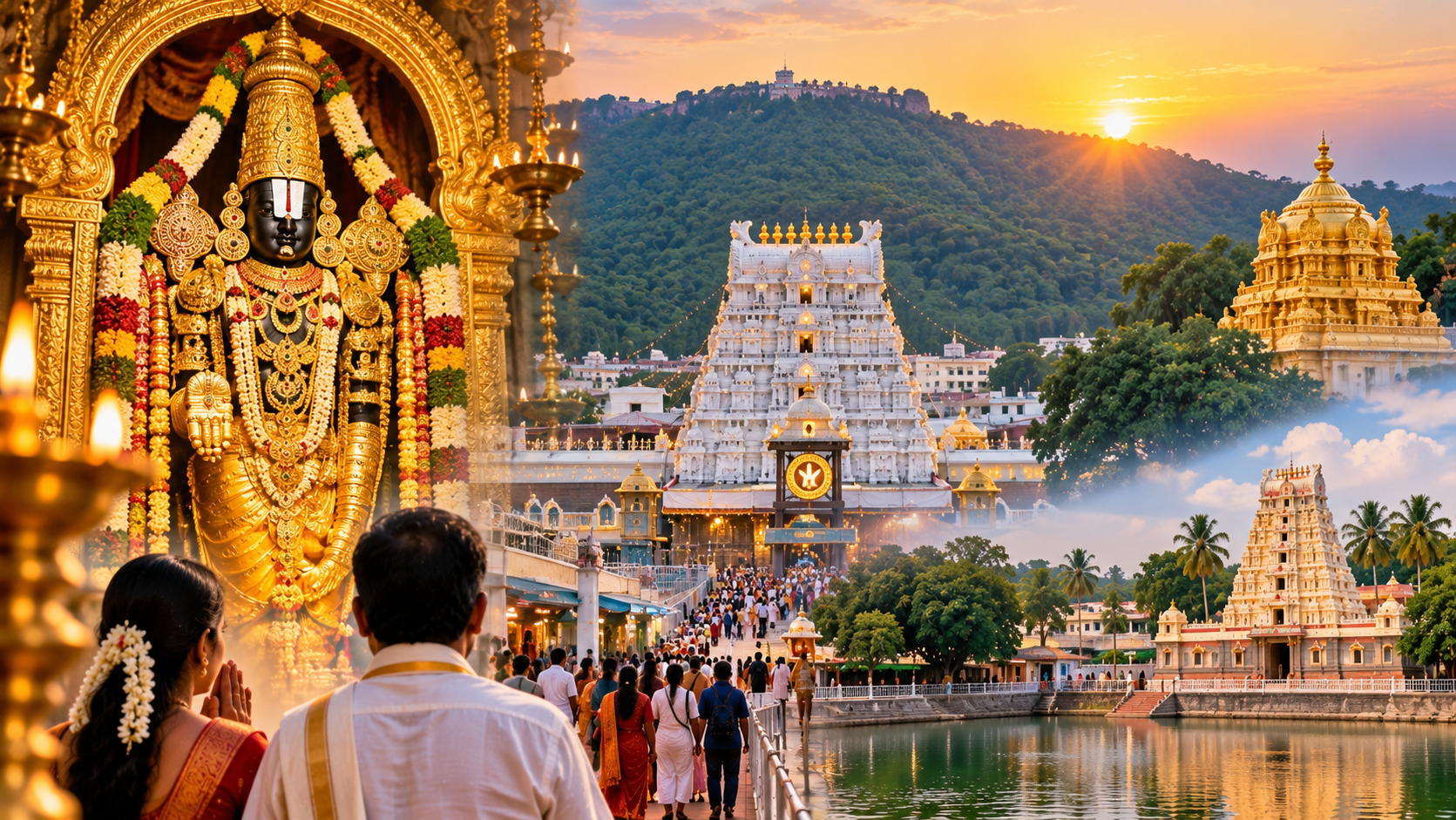
For millions of Hindus, a visit to Tirumala is far more than a journey to a famous temple. It is a pilgrimage shaped by faith, devotion and centuries of spiritual tradition.
Tirumala, Tirupati and Tiruchanur together form one of India’s most important Hindu pilgrimage landscapes. Every year, millions of devotees travel to the region to seek darshan and participate in a spiritual tradition that has continued across generations.
But as the region grows, an important question is increasingly being raised: How can modern development take place while preserving the sacred character of one of Hinduism’s most revered pilgrimage destinations?
The Global Hindu Heritage Foundation (GHHF) has proposed one possible answer—a unified recognition of Tirumala, Tirupati and Tiruchanur as a holy city and pilgrimage region, with special measures to protect their religious and cultural character.
More Than a Temple
For a pilgrim, the experience of Tirumala does not necessarily begin at the temple entrance.
The journey through Tirupati, the visit to Tiruchanur, the surrounding temples, rituals and traditions, and finally the ascent to Tirumala are all connected in the minds of devotees.
Tirumala is revered as the abode of Lord Venkateswara, while Tiruchanur is associated with Sri Padmavathi Ammavaru, the consort of Lord Venkateswara. Together with Tirupati, the three locations form an interconnected pilgrimage circuit.
This raises a larger question about how such a landscape should be planned and governed.
Should it be treated primarily as a growing urban and tourist center, or should its unique religious character be reflected more strongly in its planning and administration?
A Proposal for Sacred Status
A recent roundtable conference in Hyderabad brought this question into focus.
Organized under the auspices of GHHF, the meeting brought together representatives of more than 25 organizations, intellectuals and members of different Hindu communities.
The gathering called for Tirumala, Tirupati and Tiruchanur to be recognized as a unified holy city and pilgrimage region.
The proposal is based on the belief that a destination of such exceptional religious importance deserves a framework that gives greater consideration to its spiritual identity.
Supporters have pointed to internationally known religious destinations such as Mecca and Vatican City as examples of places where religious significance is closely reflected in the character and administration of the destination.
The circumstances of each place are obviously different, but the comparison raises an interesting principle: can India’s most important pilgrimage destinations have frameworks specifically designed to protect their sacred character?
Extending the Sacred Environment
One of the principal demands discussed at the conference was extending the restrictions on liquor and meat that exist in Tirumala to Tirupati and Tiruchanur.
Supporters argue that the environment surrounding a major pilgrimage center should be consistent with the expectations of devotees and the religious nature of the destination.
For many pilgrims, travelling to Tirumala is a deeply personal spiritual experience. They may travel hundreds or even thousands of kilometres, often as part of a family tradition that has continued for generations.
The atmosphere surrounding the pilgrimage therefore matters.
The proposal is not simply about commercial regulation. It is about asking what kind of environment a major sacred destination should provide to those who come there for worship.
Protecting Religious Heritage
The conference also discussed concerns about religious activities and forms of religious persuasion around the pilgrimage region that participants believe could affect its religious character or hurt the sentiments of devotees.
GHHF has called for greater attention to such activities and for measures that protect the identity of the region as a major Hindu pilgrimage center.
At the same time, any such measures would have to function within India’s constitutional framework and existing laws.
That makes the issue more complex than simply declaring an area sacred. It requires a careful conversation about heritage, religious freedom, local communities, administration, development and the rights of millions of pilgrims.
Why Tiruchanur Is an Important Part of the Pilgrimage
Tiruchanur occupies an important place in the religious geography of the region.
The temple of Sri Padmavathi Ammavaru attracts devotees as part of their wider pilgrimage associated with Tirumala and Lord Venkateswara.
For many visitors, therefore, Tiruchanur is not a separate destination but an integral part of the spiritual journey.
Recognizing Tirumala, Tirupati and Tiruchanur as a connected pilgrimage region could encourage authorities to consider their shared religious and cultural significance when planning infrastructure and development.
Development Without Losing the Soul of the Place
Tirupati has grown substantially over the years.
The growth has brought roads, hotels, transportation facilities, commercial establishments and other infrastructure needed to accommodate the enormous number of pilgrims visiting the region.
Modern facilities are essential.
But rapid development also creates a familiar challenge for pilgrimage destinations around the world: how do you accommodate millions of visitors without allowing commercialization to overwhelm the character of the sacred place?
The answer does not necessarily lie in preventing development.
Rather, development can be guided by the identity of the destination itself.
Roads, accommodation, sanitation, public spaces, transportation and other facilities can all be designed around the needs of pilgrims while respecting the heritage and traditions of the region.
Learning From Major Pilgrimage Destinations
Across the world, some of the most significant religious destinations have distinctive systems for managing their unique character.
Mecca has a special religious and administrative framework reflecting its importance in Islam. Vatican City has a unique status as the center of the Catholic Church.
India’s religious traditions and constitutional structure are different, and no foreign model can simply be transferred to the Tirumala region.
Nevertheless, these examples demonstrate that the religious identity of a major pilgrimage destination can influence how the area is planned and protected.
The discussion around Tirumala, Tirupati and Tiruchanur asks whether India should consider a similarly distinctive approach for one of its most important Hindu sacred landscapes.
A Question for Policymakers and Devotees
Any decision concerning the status of Tirumala, Tirupati and Tiruchanur would involve multiple stakeholders.
The Tirumala Tirupati Devasthanams, the Andhra Pradesh government, local authorities, residents, religious organizations, heritage experts and devotees would all have an important role to play.
There would inevitably be different perspectives on how such a proposal should be implemented.
But the underlying question is worth discussing seriously:
What should a modern Indian pilgrimage city look like when millions of people come not merely to visit, but to worship?
Preserving a Living Tradition
Tirumala is not simply an archaeological or historical site.
It is a living center of Hindu worship.
Every day, thousands of devotees arrive with prayers, offerings and personal hopes. Families pass down the tradition of visiting Tirumala from one generation to another.
That living connection is what makes preservation particularly important.
Protecting the region does not mean freezing it in time. It means allowing it to develop while ensuring that development does not gradually erase the qualities that make the place sacred.
The Larger Meaning of the Proposal
The call for a unified holy city encompassing Tirumala, Tirupati and Tiruchanur is ultimately part of a broader conversation about India’s religious heritage.
It asks whether sacred landscapes deserve a distinct approach to planning, whether commercial activity should be regulated in accordance with their religious character, and how modern infrastructure can coexist with centuries-old traditions.
GHHF’s proposal has brought these questions into the public discussion through its roundtable and its call for greater protection of the region’s spiritual identity.
Whether or not the proposed framework is ultimately adopted, the conversation itself highlights an important reality: India’s pilgrimage centers are not merely places people travel to. They are places that carry the faith, memories and traditions of generations.
As Tirumala, Tirupati and Tiruchanur continue to evolve, the challenge will be to ensure that progress and preservation move together.

Sai Srinivas