
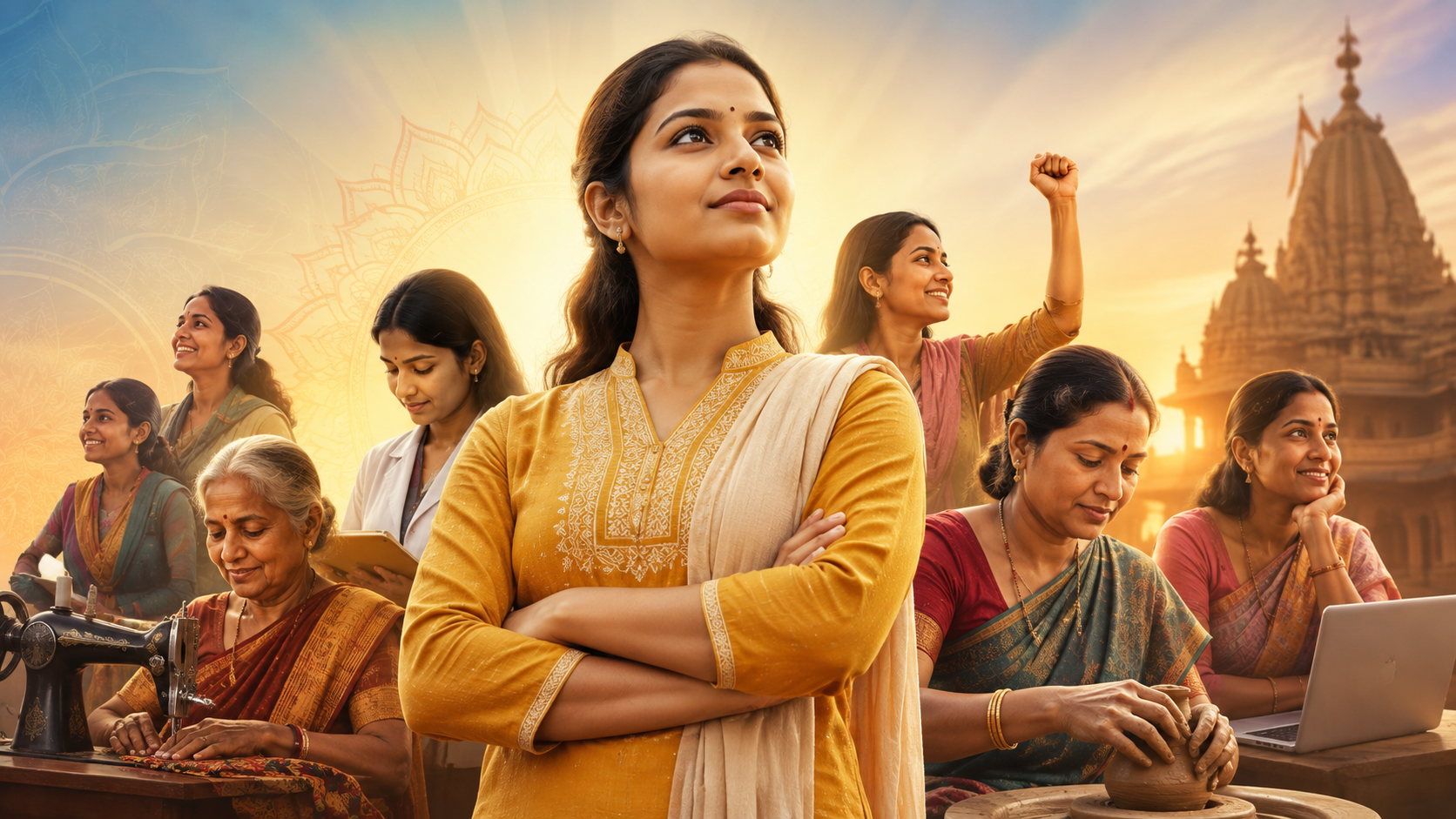
Women’s empowerment is not simply about giving women opportunities—it is about creating an environment where women can develop their abilities, earn with dignity, make informed decisions, and build a more secure future for themselves and their families.
In India, women have always played a central role in families, communities, culture, and the economy. From managing households and raising children to preserving traditions and contributing to agriculture, small businesses, education, healthcare, and professional sectors, Indian women have made immense contributions. Yet, millions of women, particularly those living in rural and economically disadvantaged communities, continue to face barriers to education, employment, financial independence, and entrepreneurship.
One of the most effective ways to address these challenges is through skills, opportunity, and economic independence.
Empowerment Begins With Opportunity
True empowerment begins when a woman is given the opportunity to learn something that can change her circumstances.
For women who may not have access to formal employment, vocational training can provide a practical pathway toward financial independence. Skills such as tailoring, embroidery, handicrafts, food processing, beauty services, digital work, and other forms of vocational training can allow women to earn an income while continuing to manage family responsibilities.
This is particularly important in rural India, where employment opportunities may be limited and mobility can sometimes be a challenge.
A skill that can be practiced from home can become the foundation of a small business, a source of household income, and eventually a sustainable livelihood.
GHHF’s Initiative: Turning Skills Into Livelihoods
The Global Hindu Heritage Foundation (GHHF) is working toward this vision through its tailoring training initiative for underprivileged Hindu women.
GHHF has established two tailoring training centers, one in the Anantapur area and another in Nandyala. Currently, 32 women are receiving training, with the program designed to be completed over two months.
The initiative focuses on more than simply teaching women how to operate a sewing machine. It aims to provide practical tailoring skills that can eventually be transformed into income-generating opportunities.
Participants can learn skills that enable them to stitch everyday clothing, school uniforms, traditional garments, festive wear, and undertake alterations and customized orders.
With experience, a trained woman may be able to establish a tailoring business from her home, build a local customer base, join a self-help group, take up subcontracting work, or explore employment opportunities within the textile and garment sector.
What begins as a vocational course can therefore become the beginning of a livelihood.
Why Women’s Economic Empowerment Matters in India
Women’s economic empowerment has consequences far beyond an individual woman’s income.
When a woman earns, she often gains greater confidence in making decisions about her family and her future. Her income can contribute toward household expenses, children’s education, healthcare, nutrition, and better living conditions.
Financial independence can also provide women with greater resilience during periods of economic difficulty.
For many women, empowerment does not necessarily mean choosing between family responsibilities and employment. Instead, it can mean having the flexibility to combine both.
This is why home-based and community-based vocational opportunities can be particularly meaningful in rural India.
From Financial Dependence to Self-Confidence
The value of vocational training cannot be measured only by the amount of money a woman eventually earns.
There is another transformation that takes place: confidence.
Learning a skill, completing a garment successfully, receiving an order, earning one’s first payment, and gradually developing a customer base can fundamentally change how a woman views her own capabilities.
She begins to see herself not merely as someone receiving assistance, but as someone capable of creating value.
She can become a skilled worker, an entrepreneur, a contributor to her household, and eventually a role model for other women around her.
That transformation—from dependency to confidence—is one of the most powerful dimensions of empowerment.
Empowering One Woman Can Strengthen an Entire Family
When a woman becomes economically capable, the benefits often reach the entire household.
Additional income can help parents provide better educational opportunities for their children, meet medical expenses, purchase school supplies, improve nutrition, and manage unexpected financial pressures.
Children also observe the importance of hard work, perseverance, responsibility, and self-reliance.
In this way, investing in women becomes an investment in the next generation.
A woman who acquires a skill today may not only improve her own circumstances but also create better opportunities for her children tomorrow.
Creating Stronger Rural Communities
Women’s empowerment also has a wider economic impact.
When women earn within their communities, their income often circulates locally. Small tailoring businesses create demand for fabrics, accessories, services, transportation, and other local economic activities.
Successful women entrepreneurs can eventually employ or train other women, creating a multiplier effect.
One trained woman can therefore become an opportunity for several others.
This is particularly valuable in rural communities, where small enterprises and self-employment can play an important role in strengthening local economies.
The Larger Picture of Women Empowerment in India
India has made significant progress in expanding opportunities for women through education, entrepreneurship, vocational training, financial inclusion, and participation in the workforce. Women today are succeeding across virtually every field—from science and medicine to business, technology, education, sports, public service, agriculture, and entrepreneurship.
However, empowerment cannot be considered complete simply because opportunities exist on paper.
Women must also have access to the resources, skills, financial support, safe working environments, education, technology, and social encouragement necessary to make use of those opportunities.
The challenge is particularly important for women from economically weaker and underserved communities.
For them, a practical skill can sometimes make the difference between continued financial dependence and the possibility of building an independent livelihood.
Dignity Through Self-Reliance
Financial assistance can provide temporary relief. Skills can provide something that lasts much longer.
A trained woman carries her knowledge with her. She can use it repeatedly, improve it with experience, teach it to others, and potentially turn it into a business.
That is why vocational education is such a meaningful form of empowerment.
A sewing machine may appear to be a simple household tool. But when placed in the hands of a trained woman, it can become an instrument of income, dignity, confidence, independence, and hope.
Investing in Women Means Investing in India’s Future
The progress of India is closely connected to the progress of its women.
When women have the ability to learn, earn, participate in economic activity, and make decisions about their futures, families become stronger and communities become more resilient.
Initiatives such as GHHF’s tailoring training centers demonstrate how relatively focused interventions can create meaningful opportunities for women who may otherwise have limited access to employment.
The goal should not simply be to provide temporary assistance. It should be to help women acquire capabilities that remain valuable long after a particular program has ended.
Empowerment begins with opportunity. It grows through skills. And it becomes sustainable through independence.

Sai Srinivas