
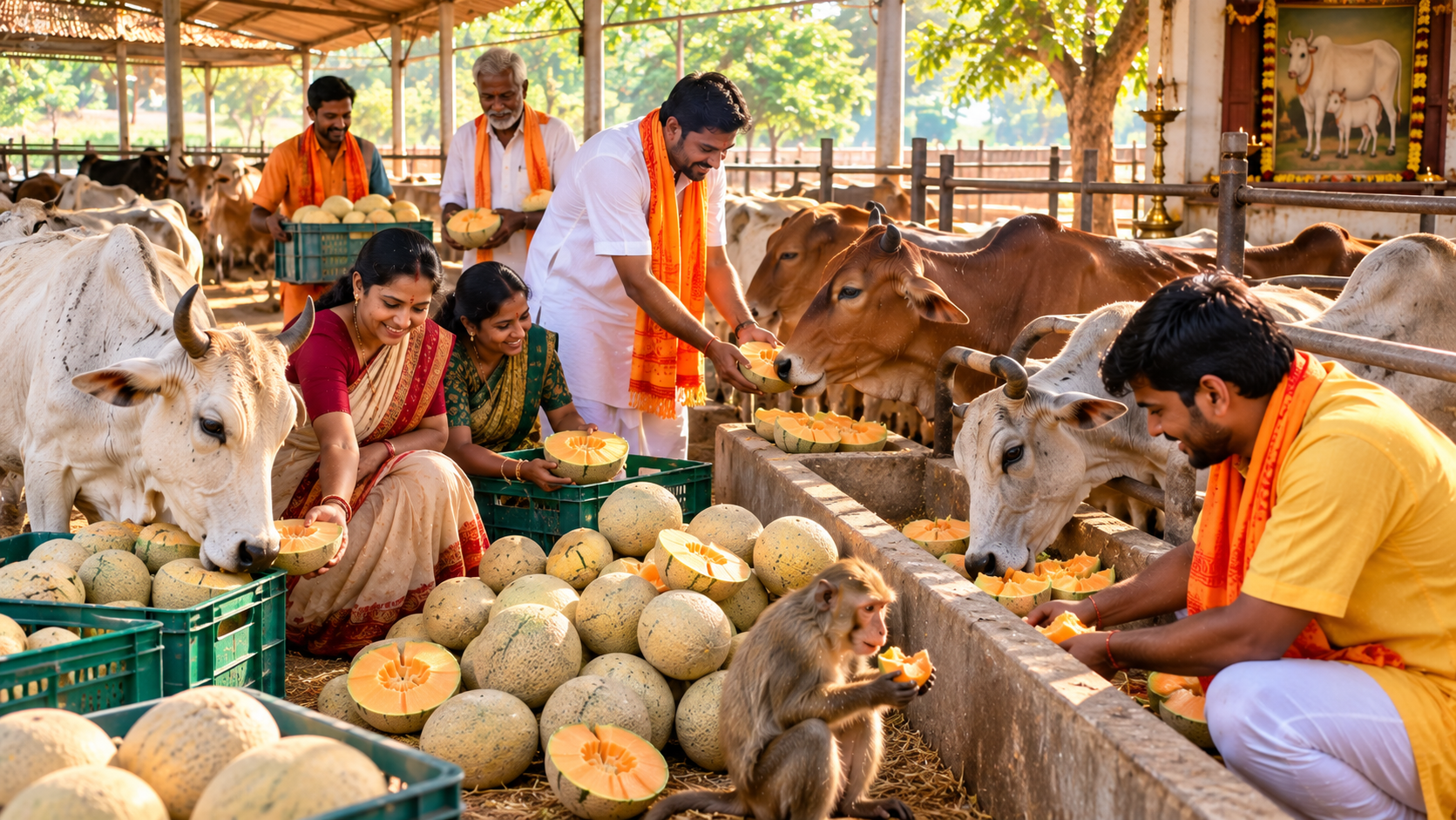
As summer intensifies, finding food and water can become a serious challenge for animals living around towns and villages. Cows, bulls, monkeys and other animals often struggle to find safe and nutritious food, sometimes resorting to eating discarded waste and plastic.
In Kalyanadurgam, Andhra Pradesh, volunteers associated with the Global Hindu Heritage Foundation (GHHF) found a simple and meaningful way to help.
When they learned that the final harvest of cantaloupes had been completed in nearby farms and that many fruits would otherwise be left behind in the fields, they approached local farmers and asked whether the surplus fruits could be used to feed animals.
The farmers readily agreed.
What followed was an example of how a small act of community cooperation can become meaningful seva.
From Farm Surplus to Animal Seva
On August 1, 2024, GHHF volunteers went to farmland in the Garudapuram area of Kalyanadurgam Mandal and collected hundreds of cantaloupes, locally known as kharbuja or karbuja.
The fruits were gathered, loaded into autos and transported to different locations where they could be distributed to cattle.
Some of the fruits were also stored at Gopi Swami’s residence before being taken out for the animals.
Cows and bulls in the area were among the primary beneficiaries. Monkeys also arrived to share in the unexpected feast.
What might otherwise have become agricultural waste was instead turned into food.
A Different Kind of Summer Relief
GHHF volunteers have previously undertaken summer initiatives aimed at providing relief to people and animals.
The organization says its Pracharaks have been providing water, buttermilk, fruits and vegetables to animals during the summer months. It has also organized Water Pandals at multiple locations to provide drinking water and buttermilk to people facing the heat.
The cantaloupe initiative naturally became an extension of this approach.
Rather than allowing edible fruit to go to waste, volunteers connected farmers who had surplus produce with animals that needed food.
It was a practical solution requiring little more than awareness, transportation and a willingness to serve.
When Farmers and Volunteers Come Together
The initiative also highlights the importance of cooperation within rural communities.
The farmers could easily have left the remaining fruits in the fields after the final cutting. Instead, they agreed to allow the volunteers to collect as many cantaloupes as they could use.
That generosity made the effort possible.
Volunteers including Gopi Chary Garu, Arjun, Anil Kumar, Hanumante, and the sons of Gopi Chary participated in the seva.
Their efforts demonstrate that animal welfare does not always require complicated programmes. Sometimes, it begins with noticing a problem and finding a practical way to address it.
Compassion Extending Beyond People
The welfare of animals has a distinctive place within India’s cultural and spiritual traditions.
The cow, in particular, has long held a revered position in Hindu society. But the broader principle of seva extends to compassion toward living beings more generally.
Providing food and water to an animal in need is therefore not merely an act of charity. For many devotees, it is also an expression of dharma and compassion.
The sight of volunteers carrying fruit from a farm and feeding hungry cattle captures that principle in a very simple form.
There is no elaborate ceremony involved.
There is simply food, an animal in need, and someone willing to help.
A Summer Challenge for Stray Animals
Summer can be especially difficult for animals living on the streets.
As temperatures rise, water sources become scarce and vegetation may dry up. Cattle wandering through towns can struggle to find appropriate food and may consume garbage, plastic bags and other harmful materials.
Such conditions can have devastating consequences for animals.
Providing clean food and water can therefore make a meaningful difference, particularly during periods of extreme heat.
The cantaloupes offered by GHHF volunteers provided both nourishment and hydration, as the fruit naturally contains a high proportion of water.
Making Use of What Nature Provides
The initiative also carries an environmental message.
Food that remains unused after harvest can become waste. At the same time, animals may be struggling to find food.
Connecting these two realities creates a simple form of resource recovery: produce that might have been discarded is redirected toward a useful purpose.
It is a reminder that reducing waste does not always require sophisticated technology.
Sometimes, it requires people to look around and ask a basic question:
Can something that is unwanted by one person be useful to someone—or something—in need?
Seva That Creates a Ripple Effect
The impact of such an initiative extends beyond the immediate feeding of animals.
Farmers are encouraged to think about how surplus produce can be put to use. Volunteers become more attentive to the needs of animals in their communities. And local residents are reminded that animal welfare can be part of everyday community responsibility.
Even the monkeys that gathered to eat the fruit became unexpected participants in the effort.
A few hundred cantaloupes may seem like a small contribution when viewed against the larger challenges facing animal welfare. But meaningful service often begins with such individual efforts.
One farm. A group of volunteers. A few autos filled with fruit. And animals that would otherwise have gone hungry.
The Spirit of Seva
The word seva carries the idea of selfless service—helping without expecting something in return.
The cantaloupe initiative reflects that spirit in a particularly tangible way.
The volunteers did not simply identify a need. They found a resource, worked with farmers, transported the produce and personally helped distribute it to animals.
It is this combination of awareness, initiative and compassion that gives the effort its meaning.
A Simple Act With a Larger Message
The story from Kalyanadurgam is ultimately about more than cantaloupes.
It is about seeing value where others might see waste. It is about recognizing the needs of animals that cannot speak for themselves. And it is about bringing together farmers, volunteers and local communities around a simple act of compassion.
For the Global Hindu Heritage Foundation, such initiatives form part of a wider commitment to community service and the welfare of living beings.

Sai Srinivas